UNLV vs Boise State Broncos Match Player Stats Analysis
College football fans often search for one thing after a big game: the real numbers behind the result. Did the quarterback dominate the air? Did the running game decide the outcome? Or did one defensive play quietly flip the entire momentum?
If you followed the Mountain West season closely, the matchup between the UNLV Rebels football and the Boise State Broncos football delivered exactly that kind of drama. The final scoreboard told one story. The player statistics told another.
I remember watching the moment when the Broncos’ offense shifted gears late in the second quarter. The run game suddenly opened up, and UNLV’s defensive line looked half a step slower. From that moment, the direction of the game changed.
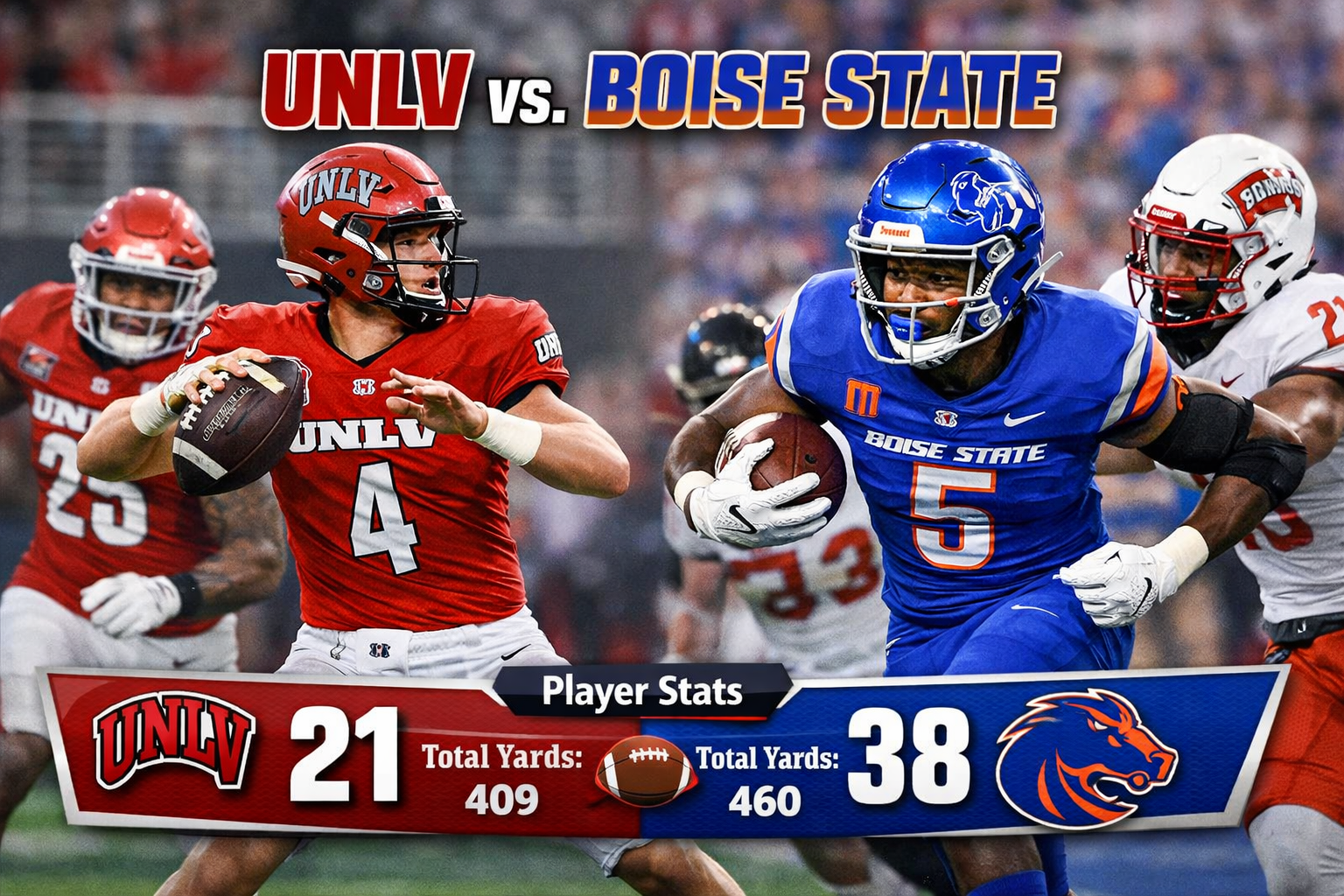
According to official NCAA and game box score data, Boise State defeated UNLV 38 to 21 in the 2025 Mountain West Championship matchup, producing 460 total yards compared to UNLV’s 409. (NCAA football statistics database)
That statistical edge might seem small, but the player-level performances reveal why the result leaned strongly toward Boise State. This article breaks down the numbers that matter: quarterback production, rushing dominance, defensive impact, and the subtle plays that shaped the contest.
Match Overview: What Happened in the Game
Before looking at individual players, it helps to understand the overall flow of the game. Boise State built an early lead, forcing UNLV into a pass-heavy strategy. That strategic shift changed the tempo of the contest.
Game summary:
| Category | UNLV | Boise State |
| Final Score | 21 | 38 |
| Total Yards | 409 | 460 |
| Passing Yards | 225 | 289 |
| Rushing Yards | 184 | 171 |
| Turnovers | 1 | 0 |
| Time of Possession | 28:40 | 31:20 |
Even though UNLV actually ran the ball efficiently, Boise State’s passing game proved more explosive. The Broncos averaged 9.3 yards per pass attempt, which is a significant advantage in college football efficiency metrics.
Ball security also made a huge difference. Boise State committed zero turnovers. That single factor often determines championship games.
The deeper question is how individual players created these numbers.
Quarterback Performance Comparison
Quarterback play is usually the clearest indicator of a team’s offensive identity.
Boise State Quarterback
Maddux Madsen delivered one of his most efficient games of the season.
Key stats:
- 17 completions on 31 attempts
- 289 passing yards
- Multiple total touchdowns
- No turnovers
The Broncos used a balanced passing attack built around mid-range routes and play action passes. When the defense stepped forward to stop the run, Madsen targeted receivers across the middle.
One moment stood out. In the second quarter, Madsen rolled to his right and delivered a 39-yard touchdown pass to Malik Sherrod. That single play stretched the lead and forced UNLV to abandon its conservative defensive scheme.
UNLV Quarterback
Anthony Colandrea had a productive game statistically but struggled with consistency.
- 18 completions on 38 attempts
- 225 passing yards
- 2 total touchdowns
Colandrea showed flashes of dual-threat ability, especially when he scrambled for rushing yards. However, the passing efficiency difference between the two quarterbacks proved decisive. Completion rate below 50 percent created repeated third-and-long situations.
This shows how efficiency can matter more than volume. Next, the ground game tells another important story.
Running Back Production and Ground Game Impact
While the passing game produced highlight plays, the rushing attack quietly shaped the tempo of the contest.
Boise State Running Game
The Broncos rotated multiple backs, keeping the defense guessing.
Top contributors:
- Dylan Riley
- 21 carries
- 75 rushing yards
- touchdown reception
- Malik Sherrod
- 71 total yards
- receiving touchdown
Boise State’s running philosophy relied heavily on zone blocking schemes. Instead of explosive 40-yard runs, they focused on consistent five to seven-yard gains, which controlled the clock.
UNLV Rushing Attack
UNLV produced strong rushing numbers as well. Anthony Colandrea contributed 66 rushing yards, demonstrating his mobility outside the pocket.
But Boise State’s runs frequently came on early downs, while UNLV’s rushing attempts often came when they were already trailing. That difference affects defensive positioning and play calling.
Defensive Player Contributions
Defense rarely gets the spotlight in stat breakdowns, but championship games are often decided on this side of the ball.
Boise State’s defensive unit limited explosive plays. Key defensive highlights included:
- Multiple third down stops
- Strong pass pressure
- Containment of outside runs
UNLV faced repeated third-and-long situations in the second half, signaling effective defensive discipline. The Broncos also forced the only turnover of the game. In a championship matchup where both teams score consistently, a single turnover can shift momentum dramatically.
Offensive Efficiency and Game Strategy
Raw statistics sometimes hide the real strategic battle. Boise State emphasized efficiency rather than volume.
For example:
- Boise State ran fewer plays than UNLV
- Yet produced more yards
- And scored more points
That efficiency came primarily from passing explosiveness. When a team averages over nine yards per pass attempt, defensive coordinators face an impossible decision. If they drop extra defenders into coverage, the running game opens up. If they stack the box to stop the run, the passing lanes widen. Boise State successfully exploited that dilemma.
UNLV, by contrast, struggled to maintain rhythm in the passing game. Their rushing attack produced respectable numbers, but the inability to stretch the field vertically limited scoring opportunities.
Key Analytical Takeaway
Source: Official game box score and Mountain West statistics reports (2025)
Context: Boise State averaged 6.7 yards per play compared to UNLV’s 5.7 yards per play in the championship matchup.
Implication: That single yard difference per play creates roughly 70 additional yards of offense across the game, which translates into two additional scoring drives.
This explains why the Broncos controlled the scoreboard even though both teams moved the ball effectively.
Historical Context of the Rivalry
Boise State has maintained a long winning streak against UNLV in Mountain West play. Several structural factors explain this pattern:
- Consistent quarterback development
- Strong offensive line recruiting
- Stable coaching philosophy
The Broncos’ system relies on physical offensive lines and disciplined defensive fronts. UNLV has improved dramatically but still struggles with defensive consistency against top conference opponents.
Understanding this context helps explain why certain player performances mattered so much.
Key Analytical Takeaway
Source: Mountain West performance trends and team statistics analysis
Context: Boise State’s offense averaged nearly 30 points per game during the 2025 season, ranking in the top half nationally for scoring efficiency.
Implication: When a team consistently reaches that scoring threshold, opponents must match offensive production rather than rely on defensive containment.
In the championship matchup, UNLV’s 21 points could not keep pace.
Standout Players of the Match
Maddux Madsen (Boise State QB)
- 289 passing yards
- multiple touchdowns
- strong pocket movement
Dylan Riley (Boise State RB)
- Multiple first down conversions
- Key third quarter drives
- Touchdown reception
Anthony Colandrea (UNLV QB)
- Led Rebels in both passing and rushing production
- Showed athletic potential despite inconsistent passing accuracy
Lessons from the Match Player Statistics
- Efficiency beats volume – Boise State ran fewer plays yet generated more offense.
- Turnovers decide championships – Zero vs one turnover often equals a touchdown difference.
- Explosive passing stretches defenses – High yards per pass attempt opens running lanes.
According to official collegiate performance data published through the NCAA football statistics database, teams with higher yards per play averages win the majority of FBS games each season.
What These Stats Mean for the 2026 Season
As the 2026 college football season begins, both programs face important transitions.
- Boise State enters the season with strong offensive continuity. Maintaining efficiency keeps them serious conference contenders.
- UNLV continues to build a competitive program. Generating over 400 total yards in a championship game shows real progress. The next step is improving defensive consistency and passing efficiency.
The next meeting between these teams could look very different if adjustments are made.
Frequently Asked Questions
Who won the UNLV vs Boise State championship game?
Boise State defeated UNLV 38 to 21 in the 2025 Mountain West Championship.
Who had the best player performance in the game?
Boise State quarterback Maddux Madsen produced the most impactful performance with 289 passing yards and multiple touchdowns.
How many total yards did each team produce?
UNLV gained 409 total yards while Boise State produced 460 yards of offense.
Which team had the stronger passing attack?
Boise State led the passing game with 289 yards and a higher yards per attempt average.
Did turnovers affect the game outcome?
Yes. Boise State committed zero turnovers while UNLV lost one possession.
Conclusion
The scoreboard showed Boise State winning by 17 points, but the player statistics reveal the deeper story behind the result. The Broncos combined efficient quarterback play, balanced rushing, and disciplined defense. Their offensive efficiency created scoring opportunities even with fewer plays.
UNLV demonstrated offensive potential with over 400 total yards, but inconsistencies in passing accuracy and defensive containment proved costly. Games are decided by dozens of small advantages: one extra yard per play, one fewer turnover, one more successful third down conversion. Over four quarters, these advantages become the difference between a competitive game and a championship victory.